Smart Digital Locks in Bangalore: Security Architecture for Modern Homes
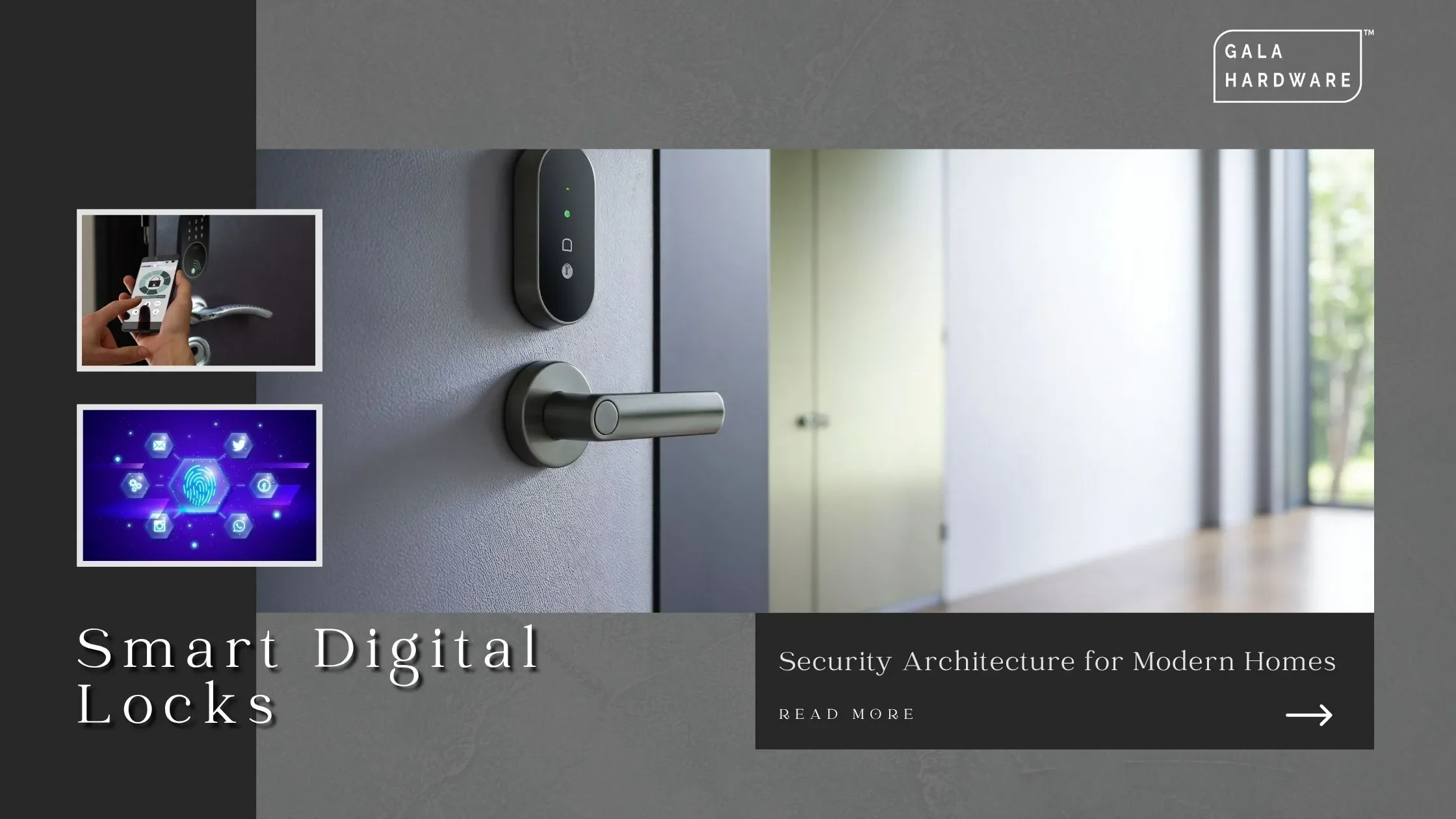
Smart digital locks represent the convergence of security engineering and architectural design. In 2026, these systems no longer announce their intelligence through clunky keypads or conspicuous cameras. Instead, biometric sensors integrate invisibly into refined hardware forms, encryption protocols operate silently behind minimalist faceplates, and access management becomes ambient infrastructure rather than conspicuous technology.
For homeowners building or renovating premium residences in Bangalore, smart digital locks solve a specific challenge: providing multi-layered security without compromising the aesthetic integrity of entry points. The question isn't whether to integrate smart access control - it's which authentication methods, connectivity protocols, and fail-safe mechanisms align with your security architecture.
At Gala Hardware World, we specify smart digital locks from manufacturers like Häfele and Yale that prioritize cryptographic security and mechanical redundancy alongside user experience. This guide outlines the technical considerations that separate robust smart lock systems from consumer-grade connected devices.
Authentication Layers: From Biometrics to Backup Keys
Modern smart digital locks employ multi-modal authentication - offering several unlocking methods within a single hardware platform. The most sophisticated systems layer three access types: biometric (fingerprint or 3D facial recognition), digital (NFC cards, smartphone credentials), and mechanical (physical key override).
Biometric authentication provides the most frictionless daily experience. Advanced systems use capacitive fingerprint sensors that scan subsurface skin layers, preventing spoofing attempts with photographs or silicon replicas. The sensor resolution determines recognition accuracy - premium locks employ 508 DPI sensors that capture fingerprint minutiae with forensic precision, enabling reliable authentication even when fingers are wet or worn from manual work.
3D facial recognition, increasingly integrated into high-end smart locks, maps facial geometry through infrared depth sensing. Unlike 2D camera systems that can be fooled by photographs, depth-mapped recognition requires living tissue with correct spatial proportions. This technology unlocks doors in 1.5 seconds without hand contact - valuable in Bangalore's monsoon season when hands might be occupied with umbrellas or groceries.
NFC (Near Field Communication) credentials offer a middle layer between biometric convenience and mechanical reliability. Smartphone-based access uses encrypted digital keys that can be granted temporarily - useful for granting service personnel or guests time-limited entry without sharing permanent credentials.
Mechanical backup remains essential despite digital sophistication. Battery failure, electronic malfunction, or cybersecurity incidents all require non-digital override capability. The best smart locks maintain cylinder mechanisms that accept physical keys, ensuring access continuity under any failure mode.
Encryption Standards: Why Bank-Grade Security Matters
The vulnerability surface of smart digital locks extends beyond physical tampering to include wireless communication interception and authentication credential theft. Encryption protocols determine whether your smart lock represents genuine security hardening or creates new attack vectors.
AES-256 encryption, the standard used in financial transactions and military communications, protects credential transmission between smartphones and lock controllers. This encryption level makes brute-force attacks computationally infeasible - even state-level adversaries with supercomputer access would require thousands of years to decrypt intercepted communications.
Two-factor authentication (2FA) adds a verification layer beyond simple credential presentation. Systems implementing 2FA require both something you have (smartphone, NFC card) and something you are (fingerprint, facial scan). This prevents unauthorized access even if credentials are compromised - a stolen phone without matching biometrics cannot unlock the door.
Firmware security receives less attention than it deserves. Smart locks are embedded computers, and like all computing devices, they run software that requires periodic security updates. Manufacturers who provide over-the-air firmware updates can patch newly discovered vulnerabilities without requiring hardware replacement. Locks without update mechanisms freeze at their factory security state, accumulating known exploits over time.
Power Management: Battery Life and Fail-Safe Design
Smart digital locks face a paradox: they must remain constantly powered for access monitoring, yet battery replacement intervals need to span months, not weeks. Advanced power management separates premium locks from budget alternatives.
Low-power Bluetooth (BLE) and optimized sleep modes allow leading systems to operate 8-12 months on standard AA batteries. The electronics draw minimal current in standby, activating fully only when proximity sensors detect approach or manual keypads receive input. Battery status monitoring provides smartphone alerts weeks before depletion, preventing unexpected lockouts.
Emergency charging ports address the scenario where batteries deplete before replacement. USB-C ports concealed beneath exterior faceplates allow temporary power from portable battery packs, providing enough charge to unlock the door and access interior battery compartments. This fail-safe design eliminates lockout risk from power exhaustion.
Solar-assisted charging, while still emerging in residential smart locks, represents the logical endpoint of autonomous power management. Photovoltaic panels integrated into exterior hardware capture ambient light, extending battery intervals indefinitely in sun-exposed installations. For south-facing entry doors in Bangalore's tropical latitude, solar supplementation could reduce battery maintenance to annual intervals.
Connectivity Architecture: Local vs. Cloud-Based Control
Smart digital locks operate through one of two connectivity models: local Bluetooth control or internet-connected cloud management. Each approach balances security, functionality, and failure resilience differently.
Bluetooth-only locks maintain all authentication locally, with encrypted communication limited to 10-meter range between smartphone and lock hardware. This eliminates remote hacking risk - an attacker must achieve physical proximity to even attempt credential interception. Bluetooth locks function independently of home internet, making them resilient to network outages or router failures. The tradeoff is limited remote management - you cannot check lock status or grant access while away from the property.
Wi-Fi-enabled locks connect to home networks, enabling cloud-based control through manufacturer apps. This architecture supports remote unlocking, real-time access logging, and temporary credential distribution from anywhere. However, it introduces internet dependency - network outages potentially compromise functionality. More critically, cloud connectivity creates attack surface through internet exposure. Robust Wi-Fi locks mitigate this risk through end-to-end encryption and regular security audits, but the attack vector exists regardless of mitigation quality.
Matter protocol, the emerging smart home standard, promises interoperability across manufacturers while maintaining local control primacy. Matter-certified locks communicate through encrypted local mesh networks, falling back to cloud services only when specifically required. This hybrid model may represent optimal balance between functional convenience and security isolation.
Integration Considerations for Bangalore Installations
Installing smart digital locks in Bangalore involves practical factors beyond feature specifications. Door compatibility, environmental conditions, and local installation expertise all impact system performance.
Door Thickness and Material Compatibility
Most smart locks accommodate standard door thickness ranges of 38-55mm, but solid teak or engineered wood doors common in premium Bangalore construction can exceed these parameters. Verify door thickness before specifying hardware to prevent installation complications or require door modification.
Humidity and Temperature Resistance
Electronic components face operational stress from Bangalore's seasonal humidity variation and direct sun exposure on certain door orientations. IP-rated housings (minimum IP54) protect internal electronics from moisture ingress. Temperature-compensated sensors maintain fingerprint recognition accuracy despite daily thermal cycling.
Professional Installation Requirements
Smart lock installation requires precise alignment of internal mechanisms, correct wiring of power components, and proper calibration of sensors. Unlike mechanical locks where slight misalignment causes minor friction, electronic deadbolts with motorized operation will bind or fail entirely with incorrect installation. Working with installers experienced in electronic hardware prevents malfunction from installation errors.
Why Specify Smart Digital Locks Through Gala Hardware World
Smart lock specification requires balancing security requirements, aesthetic integration, and long-term support infrastructure. Gala Hardware World approaches smart digital locks as security architecture, not consumer electronics. We stock Häfele and premium smart lock systems selected for encryption standards, mechanical redundancy, and manufacturer security practices.
Our technical team provides pre-installation site evaluation, verifying door compatibility and identifying environmental factors that impact sensor performance. We coordinate with installation specialists who understand electronic hardware tolerances. Post-installation, we provide ongoing support for firmware updates, credential management, and mechanical maintenance.
This comprehensive approach ensures smart digital locks function as intended - reliable, secure, and architecturally integrated.
Smart Digital Locks as Security Infrastructure
The evolution of smart digital locks reflects broader shifts in residential security from reactive barriers to proactive intelligence systems. Modern locks don't just prevent unauthorized entry - they document access patterns, adapt to usage rhythms, and integrate into comprehensive home automation ecosystems.
For homeowners investing in premium residences in Bangalore, selecting smart locks requires evaluating the same criteria applied to any critical infrastructure: encryption strength, fail-safe design, environmental resilience, and long-term support availability.
These aren't gadgets. They're security systems that happen to be beautiful.
Contact: 📞 +91 70223 30956
Location: #125, Gala Square, RV Road, Near Lal Bagh West Gate, Bengaluru - 560004
Website: galahardware.com
FAQs - Smart Digital Locks
1.What security features should you prioritize in smart digital locks?
Prioritize AES-256 encryption for credential transmission, two-factor authentication combining biometrics with digital credentials, and firmware update capability for security patch deployment. Physical backup key override ensures access during electronic failure. These four layers create defense-in-depth security architecture.
2.Are smart locks vulnerable to hacking or cyberattacks?
All internet-connected devices present attack surface. Smart locks using bank-grade encryption, local Bluetooth control, and regular security updates minimize exploit risk significantly. Bluetooth-only models eliminate remote attack vectors entirely by requiring physical proximity for any access attempt. Proper specification and firmware maintenance keep vulnerability exposure minimal.
3.How long do smart lock batteries last in Bangalore climate?
Premium smart digital locks using low-power Bluetooth and optimized sleep modes operate 8-12 months on AA batteries in Bangalore's moderate climate. Battery status monitoring provides advance depletion warnings. Emergency USB-C charging ports prevent lockout scenarios. Solar-assisted models extend intervals further through ambient light harvesting.
4.Can smart locks work without internet connectivity?
Bluetooth-only smart locks function completely offline, storing credentials locally and communicating through encrypted short-range wireless. Wi-Fi models lose remote access capability during internet outages but maintain local unlocking through biometrics and NFC. Mechanical backup keys provide fail-safe access under any connectivity scenario.
5.What door modifications are required for smart lock installation?
Most smart locks retrofit to standard door preparations without modification, accommodating 38-55mm door thickness and common backset dimensions. Solid wood doors exceeding thickness limits may require jamb adjustment or custom deadbolt sizing. Pre-installation site evaluation identifies compatibility issues before hardware specification.
6.How do biometric sensors perform in humid conditions?
Advanced capacitive fingerprint sensors scan subsurface skin layers, maintaining recognition accuracy when fingers are wet or humidity is high. Temperature-compensated sensors adjust calibration for daily thermal cycling. IP54-rated housings protect internal electronics from moisture ingress during monsoon season. Premium systems engineer specifically for tropical climate operation.
7.Which smart lock brands does Gala Hardware World recommend?
Gala Hardware World specifies Häfele and Yale smart digital locks selected for encryption standards (AES-256), mechanical redundancy with backup key systems, firmware update capability for security patches, and manufacturer support infrastructure. These brands balance sophisticated electronics with proven mechanical engineering from established hardware manufacturers.
